
Microsoft Solutions Partner for Modern Work
Exchange On-Premises to Microsoft 365 Migration
Years
Public Folder and Hybrid Expertise
Microsoft Solutions Partner for Modern Work
Built across the major agent ecosystems
Copilot Studio
Azure AI Foundry
AWS Bedrock
Google Vertex AI
OpenAI
LangChain / LangGraph
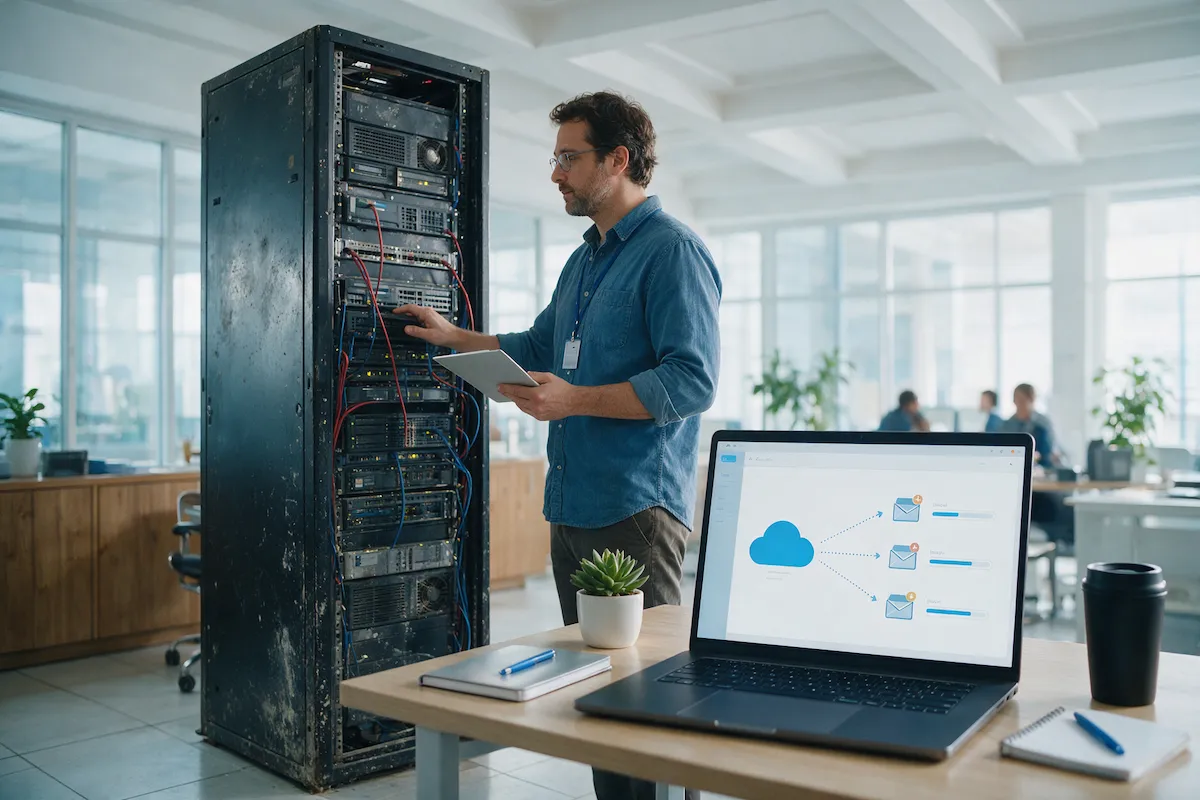
Exchange Migration Challenges That Create Risk
01
Exchange Server end-of-support approaching — or already passed?
02
Maintaining on-prem Exchange hardware, patching, and certificates is expensive and thankless?
03
Users want Teams, Copilot, and modern M365 features they can’t get on-prem?
Worried about data loss, downtime, or disruption during migration?
What We Do
01
Complete migration — nothing left behind
We migrate mailboxes, calendars, contacts, public folders, shared mailboxes, distribution lists, and transport rules — the complete exit.
02
Right approach for your size
Cutover for small environments, hybrid for enterprise — we choose the right migration method for your mailbox count and downtime tolerance.
03
Minimal disruption
We migrate in waves with coexistence so users keep working during the transition — no big-bang weekend outage.
High fidelity — nothing lost
Email history, attachments, folder structure, calendar items, and permissions migrate with full fidelity.
05
Public folders handled
We migrate or modernise public folders — the part that stops most Exchange migrations — to M365 Groups, shared mailboxes, or SharePoint.
06
A Clean On-Premises Exit
After migration validation, plan and execute Exchange decommissioning with appropriate documentation and identity configuration cleanup.
Our Services & Capabilities
01
Migration Assessment & Planning
Assess Exchange versions, mailboxes, public folders, connectors, and dependencies to define the right migration approach.
- Exchange environment audit
- Migration approach design
- Phased plan
02
Mailbox Migration
We migrate user mailboxes, shared mailboxes, and resource mailboxes to Exchange Online — in waves, with full history and fidelity.
- User mailboxes
- Shared & resource mailboxes
- Full history & attachments
03
Calendar & Contact Migration
We migrate calendar data, contacts, and distribution lists with accuracy — preserving appointments, recurring meetings, and group membership.
- Calendar migration
- Contacts
- Distribution lists → M365 Groups
04
Public Folder Migration
We migrate or modernise public folders — to M365 public folders, M365 Groups, shared mailboxes, or SharePoint — depending on usage and best fit.
- Public folder migration
- Modernisation options
- Usage-based recommendation
05
Transport Rules & Connectors
We migrate or rebuild mail flow rules, connectors, accepted domains, and send/receive configurations to Exchange Online.
- Transport rules
- Connectors
- Accepted domains
- Mail flow
06
Hybrid Configuration (if needed)
For organisations needing coexistence, we configure Exchange Hybrid — free/busy, mail routing, and directory sync — during and optionally after migration.
- Hybrid setup
- Free/busy coexistence
- Directory sync
07
DNS, MX & Server Decommission
We cut over MX records, update DNS, validate delivery, and decommission on-premises Exchange servers — a documented, clean exit.
- MX cutover
- DNS updates
- On-prem decommission
- AD cleanup
Migrating from Lotus Notes instead? See Notes to M365 Migration. From Google Workspace?
Which Migration Approach Fits You?
| Your situation | Recommended approach | What it means |
|---|---|---|
< 150 mailboxes, simple environment | Cutover migration | All mailboxes moved at once, quick DNS cutover |
150+ mailboxes, need coexistence | Hybrid migration | Mailboxes moved in waves, free/busy coexistence, minimal disruption |
Exchange 2013 (out of support) | Hybrid or cutover (urgent) | Pre-work needed for hybrid; cutover if small enough |
Exchange 2016/2019 | Hybrid migration | Standard hybrid path, well-supported |
Large public folder estate | Hybrid + public folder planning | Public folders migrated or modernised as a separate stream |
Strict zero-downtime requirement | Hybrid with batch migration | Mailboxes moved in small batches during business hours |
Already running hybrid, want to finish | Hybrid completion | Move remaining mailboxes and decommission on-prem |
Already running hybrid, want to finish | Hybrid completion | Move remaining mailboxes and decommission on-prem |
Not sure what we need | Start with an assessment | We assess and recommend the right approach |
The estimator above gives you a cost and timeline; a free consultation confirms the right approach for your environment.
Technical delivery includes pre-migration discovery, identity and directory readiness checks, mail flow and connector mapping, pilot migration validation, staged wave planning, post-migration mailbox and calendar verification, DNS cutover support, rollback planning, and documented decommission steps.
Our Exchange Migration Methodology
Security and governance considerations include admin role scoping, MFA and Conditional Access readiness, secure connector handling, audit and retention review, mailbox permission validation, transport rule testing, and post-migration monitoring for mail flow, sign-in, and delivery issues.
Free consultation & assessment
We review your Exchange environment — version, mailbox count, public folders, mail flow, and dependencies — and recommend the right migration approach. No cost, no obligation.
Pre-migration preparation
We prepare the environment: Entra ID sync (if not in place), M365 tenant configuration, DNS verification, and hybrid configuration where needed.
Pilot migration
We migrate a pilot batch (IT team, early adopters) to validate the approach, confirm fidelity, and identify any issues before scale.
Wave migration
We migrate remaining mailboxes in scheduled waves — typically by department or location — with user communication and support.
Public folders & shared resources
We migrate or modernise public folders, shared mailboxes, and resource mailboxes as a coordinated stream.
MX cutover & validation
We cut over MX records, update DNS, validate mail delivery, and confirm all mailboxes are receiving in Exchange Online.
Decommission & cleanup
We decommission on-premises Exchange servers, clean up Active Directory, and document the completed migration.
It starts with a free Exchange migration assessment. No obligation.
Why Star Knowledge
| Criteria | Star Knowledge | In-House IT | Generic MSP |
|---|---|---|---|
Exchange migration depth | 100+ migrations, all versions | First-time risk | Variable |
Public folder handling | Migrated or modernised | Avoided or broken | Basic |
Hybrid expertise | Configured and managed | Partial, fragile | Template-based |
Fidelity | Full — mail, calendar, contacts, rules | Variable | Best-effort |
Coexistence during migration | Standard practice | Risky | Variable |
Decommission & cleanup | Documented, clean exit | Incomplete | Not offered |
Broader M365 readiness | Identity, security, Intune, Teams | Out of scope | Email-only |
Track record | 15+ years, 100+ migrations | In-house |
Mixed |
Case Studies
Investment advisory firm in Financial Services, headquartered in San Francisco, CA, with offices in New York, Fort Lauderdale, Chicago, and London
Microsoft 365, Azure, Exchange 2013 → 2019, Azure Active Directory, Barracuda
Spam control, tenant migration, and support across multiple geographies
A full Exchange-to-cloud migration with DR, security, and spam protection built in

Financial services firm, 200+ mailboxes, Exchange 2013 (out of support).
Exchange 2013 → Exchange Online, compliance archive migration
Exchange 2013 was out of support with compliance exposure; the firm needed to migrate urgently.
Cutover migration with archive preservation — completed over a weekend with zero mail loss and compliance continuity.
Professional services firm, 300+ mailboxes, stuck in hybrid.
Exchange hybrid completion, remaining mailboxes + decommission
Developers deployed manually via RDP, there was no CI/CD, and production incidents took days to resolve.
Migrated remaining mailboxes, resolved the issues that caused the stall, and decommissioned on-premises Exchange.
Industries We Serve
Financial Services
Compliance-sensitive migration with archive preservation
Manufacturing
Multi-site Exchange estates with public folders
Professional Services
Calendar-heavy, collaboration-intensive migrations
Healthcare
HIPAA-aligned migration with encryption continuity
Legal
Large mailboxes, archive fidelity, and eDiscovery continuity
Retail
HQ + store mailbox migration at scale
Government
Regulated migration with retention requirements
Education
Staff, faculty, and student mailbox migration
From a 50-mailbox cutover to a 5,000+ mailbox enterprise hybrid migration, we scale to fit.
Insights
On-Premises Exchange Has No Future (2026)
In 2026, many organisations are re-evaluating on-premises Exchange because support timelines, security expectations, cloud-first feature delivery, and operating costs have changed. Exchange 2013 is unsupported, Exchange 2016 extended support ended in October 2025, and Exchange 2019 is approaching the next phase of Microsoft’s lifecycle. For most organisations, Exchange Online offers a stronger long-term path for security, compliance, Microsoft 365 integration, and Copilot readiness.
01
End of support is real — Exchange 2013 is unsupported; 2016 support has ended; 2019’s clock is ticking
02
03
Can we stay on Exchange on-premises?
Technically yes, but practically not sustainably. Microsoft’s Exchange Server Subscription Edition (SE) offers a path for those who must keep on-prem mailboxes, but features, security, and AI investment are cloud-first. For most organisations, Exchange Online is more secure, more capable, lower total cost, and the only way to access Copilot and modern M365 features. The question isn’t whether to move — it’s how quickly.
Frequently Asked Questions
What does your Exchange to M365 migration service cover?
We cover the complete migration from on-premises Exchange Server to Exchange Online: mailbox migration, calendar and contacts, public folders, shared and resource mailboxes, distribution lists, transport rules, hybrid configuration, MX cutover, and on-premises server decommission.
Which migration approach do you recommend — cutover or hybrid?
Cutover for environments under ~150 mailboxes where a single weekend cutover is acceptable. Hybrid for anything larger — it allows coexistence, batch migration in waves, and minimal disruption. Most enterprise migrations are hybrid. We assess and recommend based on your environment.
Will we lose any email or calendar data?
No. We migrate with high fidelity — email history, attachments, folder structure, calendar items (including recurring), contacts, and permissions. We validate completeness after each wave before proceeding.
Can you handle our public folders?
Yes — public folders are one of the most common blockers in Exchange migrations, and we handle them routinely. Depending on usage, we migrate them to M365 public folders, modernise them to M365 Groups or shared mailboxes, or move content to SharePoint. We assess each and recommend the best fit.
How long does an Exchange migration take?
It depends on mailbox count and size. A 50-mailbox cutover runs 1–2 weeks. A 250-mailbox hybrid migration runs 3–6 weeks. A 500+ mailbox enterprise migration runs 6–12 weeks. The estimator above gives an instant ballpark; a consultation produces a phased plan.
How much does it cost?
It depends on volume, approach, and public folder complexity. The pricing calculator uses a planning range of $400–$600 per migration day. A consultation validates the mailbox count, average mailbox size, public folder scope, hybrid requirements, and cutover timeline before a scoped estimate is shared.
Can we run hybrid (on-prem and cloud) during the migration?
Yes — hybrid coexistence is the standard approach for most migrations. Users on Exchange Online and users still on-prem can see free/busy, share calendars, and email each other seamlessly. We maintain hybrid until all mailboxes are moved, then decommission on-prem.
What about our Exchange 2013 — it's out of support?
Exchange 2013 is out of support and should be migrated urgently. We can do a direct cutover (small environments) or set up hybrid via a 2019 intermediary if needed. The priority is getting off an unsupported platform as quickly as possible.
Book My Free Exchange Migration Assessment
Tell us the task you have in mind. We’ll assess whether an agent suits it, at what autonomy level, and what the first step should be.
- No cost, no obligation
- Typically responds within 4 business hours
- Confidential — your data isn't shared
- Microsoft Solutions Partner for Modern Work
Typically responds within 8 business hours · Confidential