
Microsoft Solutions Partner
Agents that act, with guardrails
Agentic AI Development Services
Build AI agents that reason through tasks, use approved tools, and work across business systems—with permissions, monitoring, and human oversight.
AI & Data Projects
Microsoft, AWS, Google Cloud, OpenAI & Open-Source AI Delivery
Built across the major agent ecosystems
Copilot Studio
Azure AI Foundry
AWS Bedrock
Google Vertex AI
OpenAI
LangChain / LangGraph

Where Agentic AI Can Make the Difference
01
Unsure where AI agents can deliver value safely—or which tasks are suitable for agentic automation?
02
Agents behave unpredictably or struggle to complete multi-step tasks reliably?
03
Need AI that can take approved actions across business systems, not just generate text?
Concerned about permissions, governance, and controlling what autonomous AI can do?
What We Do
Build AI Agents You Can Trust to Act
01
Agents that act, not just talk
We build agents that reason through tasks, use your tools, and take real actions — not just generate responses.
02
Right-sized autonomy
We design the autonomy level to match the task and its risk — assisted, supervised, or autonomous.
03
Guardrails & observability
Proven before production
05
Grounded in your data
We ground agents in your knowledge with RAG and memory so reasoning is based on your reality.
06
Platform-flexible delivery
Choose platforms and frameworks based on your systems, data, governance, integrations, and support requirements.
Our Services & Capabilities
01
Single-Agent Design & Build
Build focused agents for defined tasks with appropriate autonomy levels, tools, and guardrails.
- Task-scoped agents
- Autonomy-level design
- Scoped, reliable design
02
Multi-Agent Systems & Orchestration
Coordinate specialised agents to collaborate, hand off tasks, and manage complex multi-step processes.
- Specialised agent teams
- Orchestration & hand-offs
- Complex workflows
03
Tool & System Integration
Connect agents securely to applications, APIs, workflows, and enterprise data for approved, auditable actions.
- API & system actions
- Secure, permissioned access
- Enterprise integration
04
RAG & Knowledge Grounding
Ground agent reasoning in approved business knowledge using RAG, memory, and state where appropriate.
- Retrieval-augmented grounding
- Agent memory & state
- Accurate, sourced reasoning
05
Governance, Guardrails & Observability
Control agent actions with permissions, guardrails, logging, monitoring, and human approval gates.
- Guardrails & action limits
- Logging & monitoring
- Human approval gates
06
Cross-Platform Agent Development
Build agents on Microsoft, AWS, Google Cloud, OpenAI, or open-source frameworks based on your requirements.
- Microsoft
- AWS
- Google Cloud
- OpenAI
- Open-source frameworks
07
Agent Strategy, PoC & Evaluation
Identify suitable agent use cases, validate value through PoCs, and evaluate reliability before production.
- Suitability assessment
- Proof of concept
- Evaluation & red-teaming
How An Agent we Build Fits Together
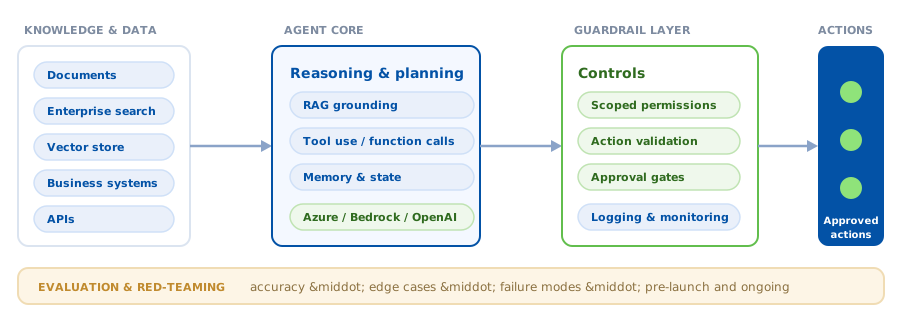
A dependable agent architecture should include task scope, tool permissions, identity and access controls, retrieval and grounding, memory or state handling, action validation, human approval gates, observability, evaluation datasets, red-teaming, fallback paths, and ongoing monitoring.
Platforms, Models & Frameworks We Build On
We build agentic AI solutions across major cloud and open-source ecosystems. The platform choice depends on your current systems, data access, security model, integration needs, and long-term support requirements.
| Category | Platforms, frameworks, and solution components |
|---|---|
Microsoft AI stack | Copilot Studio, Azure AI Foundry, Azure AI Agent Service, Azure OpenAI |
AWS AI stack | Amazon Bedrock, Bedrock Agents, Knowledge Bases for Amazon Bedrock, |
Google Cloud AI stack | Vertex AI, Vertex AI Agent Builder, Gemini models, BigQuery, Document AI. |
OpenAI ecosystem | OpenAI APIs, assistants, retrieval, model orchestration |
Open-source agent frameworks | LangChain, LangGraph, LlamaIndex, CrewAI, N8N and custom orchestration layers where a simpler workflow is a better fit. |
RAG, data & search | Vector databases, enterprise search, document ingestion, embeddings, metadata filtering, retrieval, grounding, and data-quality workflows. |
Integration & automation | REST APIs, GraphQL, webhooks, queues, workflow engines, RPA, Power Automate, Logic Apps, custom connectors, CRMs, ERPs, ticketing systems, and knowledge bases. |
Selection principle: We recommend the stack based on the workload, existing infrastructure, governance needs, integration depth, security requirements, and maintainability.
What Should The Agent Do?
| Your goal | Agent we build | Typical autonomy level |
|---|---|---|
Resolve routine customer/IT requests | Service agent with tool access | Supervised → autonomous over time |
Run multi-step research/analysis | Research / analysis agent | Supervised, human reviews output |
Automate a knowledge-heavy process | Workflow agent + integrations | Supervised with approval gates |
Coordinate several specialized steps | Multi-agent system | Orchestrated, human oversight |
Draft and act on routine actions | Assisted agent (human approves) | Assisted / human-in-the-loop |
High-stakes decisions | Decision-support agent (not autonomous) | Assisted only — human decides |
Not sure what’s right — or safe — for your task? The suitability assessment above recommends the autonomy level, and a free consultation confirms it.
How We Build Agents
Free consultation & suitability assessment
We assess whether the task suits an agent and at what autonomy level — and we’ll say if it doesn’t. No cost, no obligation.
Agent design
We design the agent’s scope, tools, knowledge (RAG), memory, autonomy level, and guardrails before building.
Proof of concept
We build a focused PoC on a real task to prove the agent is reliable and useful before scaling.
Build
We build the agent — reasoning, tool integrations, grounding, and memory — on the right framework.
Evaluation & guardrail testing
We test rigorously: accuracy, edge cases, and red-teaming, plus the guardrails that constrain what the agent can do.
Deployment with observability & oversight
We deploy with logging, monitoring, and human approval gates so you can see and control what the agent does.
Monitoring, optimisation & support
We monitor behaviour and accuracy in production, tune and re-evaluate, and adjust autonomy as trust is earned.
Why Star Knowledge
| Criteria | Star Knowledge | In-House / Experiments | Generic Dev Shop |
|---|---|---|---|
Agent architecture | Scoped, reliable design | Demo-driven | Shallow |
Autonomy decisions | Right-sized to risk | Over-ambitious | Whatever’s asked |
Tool / system integration | Secure, permissioned | Prototype-level | Variable |
Guardrails & observability | Built in | Often missing | Not considered |
Evaluation / red-teaming | Rigorous, pre-launch | Skipped | Skipped |
Production readiness | Engineered to ship | Stuck at demo | Hand-off and gone |
Framework breadth | Microsoft + AWS + Google Cloud + OpenAI + open-source | One tool | Limited |
Track record | 25+ AI & data projectsTrack record | First-time | Mixed |
Case Studies
Global logistics enterprise, 12,000+ employees
Agentic AI, ERP, CRM, TMS, Conversational AI, Machine Learning
Manual bottlenecks and fragmented data slowing the business down
Role-based AI agents wired into the enterprise ecosystem
Professional services firm, analyst team.
Multi-step agent with RAG, web tools, Azure OpenAI
A multi-step research task consumed analyst hours every week.
Built an agent to gather, summarise, and draft findings, with a human reviewing before use.
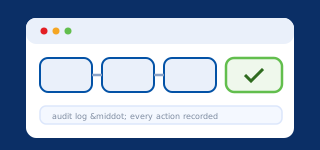
Financial services firm, operations team.
Orchestrated multi-agent system, API integration, human-in-the-loop
A complex internal process spanned several systems and required multiple handoffs.
Built orchestrated agents with human approval gates at key decision points.
Industries We Serve
Customer Support
Service agents that resolve routine requests
IT & Helpdesk
Agents that triage and action common tickets
Financial Services
Research and reconciliation agents (with oversight)
Professional Services
Knowledge and document agents
Sales & Marketing
Research, outreach drafting, and CRM-update agents
Operations
Multi-step process agents with approval gates
Healthcare
Administrative agents with strict human-in-the-loop
Software / SaaS
Agents embedded in your product
From a single supervised agent to orchestrated multi-agent systems, we scale autonomy as trust is earned.
Insights
Blog
Top Use Cases of Agentic AI for Enterprises in 2026
Blog
Why Agentic AI is Key for Modern Enterprise Digital Change
Blog
Robotic Process Automation vs API Integration: Key Differences Explained
Agentic AI in 2026: from demos to dependable
2026 is the year agentic AI moved from demo to deployment — and the year the gap between the two became obvious. Anyone can show an agent doing something impressive once; the hard part is an agent that’s reliable on the hundredth messy, real-world case, that you can audit, and that never quietly does something it shouldn’t. Getting there is engineering, not magic.
01
Right-sized autonomy — most production value is in scoped, supervised agents, not fully-autonomous everything
02
03
How do guardrails and evaluation work together to keep agents safe?
Safety is a design property, not an afterthought. Before launch, we red-team the agent to surface failure modes, scope exactly which tools and systems it can touch, and validate every action against those boundaries. In production, every step is logged so you can trace what the agent did and why, and human approval gates sit in front of any high-impact action. The result is an agent whose behaviour is bounded by design, not by hope.
Frequently Asked Questions
What is agentic AI, and what can agents actually do?
Agentic AI means AI agents that reason through a goal, use tools and systems, and take actions to complete a task — not just answer questions. Star Knowledge’s agentic AI development services cover agents that resolve service requests, run multi-step research, automate knowledge-heavy processes, and coordinate as multi-agent systems — all with governance and human oversight where it matters.
How is an AI agent different from a chatbot or copilot?
A chatbot answers questions and a copilot assists a person, but an agent pursues a goal and takes actions — often across several steps and systems. The key difference is action: with the right tools and permissions, an agent does the work rather than just telling someone how to. That power is why governance matters.
Will the agent be fully autonomous, or is there a human in the loop?
That’s a deliberate design choice based on the task and its risk. We use the right autonomy level — assisted (human approves), supervised (agent acts, human monitors), or autonomous within limits. For high-stakes work we keep humans in the loop on purpose; we won’t over-promise autonomy that isn’t safe.
How do you keep agents safe and stop them doing the wrong thing?
With layered controls. We scope what an agent can access, validate actions before they run, log every step, and add human approval gates on high-impact actions. We red-team agents to find failure modes before launch and monitor them in production. Safety is engineered in, not hoped for.
Can agents use our existing systems and data?
Yes — that’s what makes them useful. Through tool use (function calling) we connect agents to your applications, APIs, and data so they can take real actions, and we ground them in your knowledge with RAG. Access is secured and permission-bound.
Which frameworks and platforms do you use?
We build with Microsoft Copilot Studio, Azure AI Agent Service, Azure OpenAI, AWS Bedrock Agents, Google Vertex AI Agent Builder, OpenAI APIs, Semantic Kernel, LangChain, LangGraph, LlamaIndex, CrewAI, AutoGen, and custom orchestration. We choose the framework based on your systems, data, governance, risk, and production requirements.
How much does an agentic AI project cost, and how long?
Pricing depends on agent scope, integrations, data readiness, governance requirements, and production support. A focused PoC is typically the lowest-risk starting point, while production agents and multi-agent systems require a scoped estimate after discovery.
Should we start with a proof of concept?
For agents, almost always yes. Agentic systems are powerful but their reliability depends on the specific task and data, so a PoC proves an agent works — and works safely — before production investment. We’ll be honest if a task doesn’t suit an agent today.
Book My Free Agent Consultation
Tell us the task you have in mind. We’ll assess whether an agent suits it, at what autonomy level, and what the first step should be.
- No cost, no obligation
- Typically responds within 4 business hours
- Confidential — your data isn't shared
- Microsoft Solutions Partner — Business Applications
Typically responds within 8 business hours · Confidential
Microsoft Solutions Partner
Agents that act, with guardrails
Agentic AI Development Services
Build AI agents that reason through tasks, use approved tools, and work across business systems—with permissions, monitoring, and human oversight.
Backed by 15+ years in software, 50+ AI specialists, and a deep AI & data practice.
Is your task a good fit for an agent — and at what autonomy level?
The full report adds a suitability breakdown, key risks and guardrails, and a suggested first step.
Your full suitability breakdown, recommended autonomy level, risks and guardrails, and suggested first step are on their way. We’ll follow up to arrange a consultation.
A quick assessment of task fit and the right autonomy level; a consultation confirms feasibility, guardrails, and scope.